
lazyppl
Lazy Probabilistic Programming Library
https://lazyppl-team.github.io/
| LTS Haskell 23.28: | 1.0 |
| Stackage Nightly 2026-11-08: | 1.1.0.1 |
| Latest on Hackage: | 1.1.0.1 |
lazyppl-1.1.0.1@sha256:b20987af5b12612e6a6648ca4fa2b40e5cc53e6bde8ad758989adc23969869de,6906Module documentation for 1.1.0.1
LazyPPL
LazyPPL is a Haskell library for Bayesian probabilistic programming, drawing on the fact that lazy data structures are a natural idiom for programming with infinite-dimensional Bayesian methods such as Poisson/Gaussian/Dirichlet processes.
The crucial semantic idea, inspired by developments in synthetic probability theory, is to work with two separate monads: an affine monad of probability, which supports laziness, and a commutative, non-affine monad of measures, which does not. This gives a Metropolis-Hastings implementation that works with lazy programs.
The main LazyPPL modules are on Hackage and Stackage. Various worked examples in literate Haskell are at https://lazyppl-team.github.io.
Laziness lets us specify non-parametric models cleanly: processes or infinite-dimensional functions only have their finite explored portion materialised. We have first-class
- stochastic memoization:
memoize :: (a -> Prob b) -> Prob (a -> b) - Gaussian processes:
wiener :: Prob (Double -> Double) - point processes:
poissonPP :: Double -> Double -> Prob [Double](in the example demos) - Dirichlet processes:
dp :: Double -> Prob a -> Prob (Prob a)
Examples
WienerDemo(lhs) is a simple implementation of regression using a Wiener process. Via maintaining a hidden table of previous calls, it appears to be a bona fide random function $R\to R$ constructed lazily. Some values are sampled during simulation, others during plotting.

RegressionDemo(lhs) demonstrates piecewise linear regression. The change points are drawn from a lazy Poisson process.

Clustering(lhs) contains some simple clustering examples, where the number of clusters is unknown. Stick-breaking is lazy, and we use stochastic memoization.

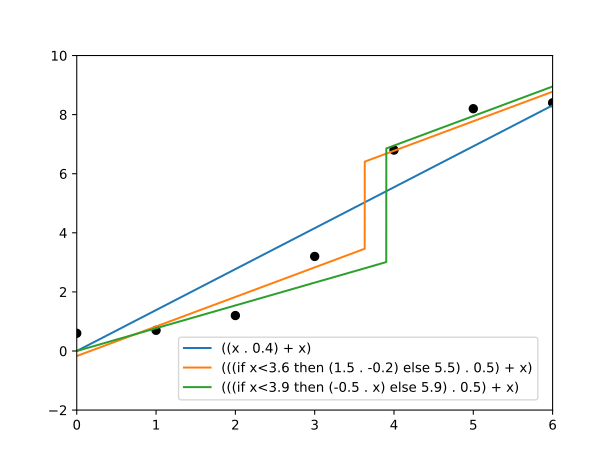
ProgramInduction(lhs) is a simple example of program induction over an arithmetic language. Random expressions are represented as an infinite forest with a finite path through it.
- Feature extraction via the Indian Buffet Process, and relation inference via the Mondrian Process and a Chinese-Restaurant-Process-based Infinite Relational Model.
Library
LazyPPL.hsprovides the core monads and inference.Probis an affine monad of probability measures.Measis a non-affine monad of unnormalised measures withsampleandscore. The Metropolis-Hastings algorithmmhtakes a probabilitypof changing any given site of the rose tree of random seeds. Settingp=1/num_sitesapproximates single-site MH andp=1recovers multi-site MH. We can’t compute the number of active sites without forcing more of the lazy tree, so we use thisp-parameterised form. A second algorithm,mh1inlazyppl-singlesite, implements a single-site proposal kernel by inspecting the Haskell heap.LazyPPL/Distributions.hsandLazyPPL/Distributions/*provide common distributions and abstract types capturing exchangeability. For example,newCustomer :: Restaurant -> Prob Tablefor the Chinese Restaurant Process (DirichletP.hs) andRestaurant -> Prob [Dish]for the Indian Buffet Process (IBP.hs).
Installation
Build with Cabal: install GHCup for GHC 9.14.1 and Cabal 3.18.2.0, then cabal update and cabal build in the repo root. First build takes a few minutes.
Run a demo: cabal run -fdemos wiener-exe (or regression-exe, clustering-exe, etc.), or explore in the REPL with cabal repl lib:lazyppl.
The library is pure Haskell and needs no LAPACK or BLAS installation. The plotting demos use the matplotlib Haskell wrapper, which calls into Python: sudo apt-get install -y --no-install-recommends python3-matplotlib python3-numpy python3-scipy python-is-python3.
To try lazyppl in your browser without installing anything, click  . This opens a ready-to-use VS Code environment with GHC and Cabal already in place.
Writing your own probabilistic models
Under executables: in examples/package.yaml, add a stanza and run hpack examples (0.39.6) to regenerate examples/lazyppl-examples.cabal:
executables:
  # ...
  mymodel-exe:
    main:                MyModel.hs
    source-dirs:         models
    ghc-options:
    - -threaded
    - -rtsopts
    - -with-rtsopts=-N
    - -main-is MyModel
    dependencies:
    - lazyppl
Run with cabal run mymodel-exe, or open in the REPL: cabal repl exe:mymodel-exe.