
crackNum
Crack various integer and floating-point data formats
http://github.com/LeventErkok/CrackNum
| LTS Haskell 24.56: | 3.15 |
| Stackage Nightly 2026-08-25: | 4.2 |
| Latest on Hackage: | 4.2 |
crackNum-4.2@sha256:899fadb5f8b869d01dc72a4c8aa53c47397a8f39c9a3c47d62032648c431ca31,2342Module documentation for 4.2
There are no documented modules for this package.
Decode/Encode Integers, Words, and IEEE754 and other float formats
crackNum shows you exactly how a number is laid out in memory: the bit
pattern, its fields, the classification, and the value in binary, octal,
decimal, and hex. It works in both directions:
- Encoding: give it a value (
2.5,-2.3e6,NaN,0x3.2p5), and it shows the bit-pattern it turns into, together with the rounding that took place. - Decoding: give it a bit-pattern (
0xdeadbeef,0b0110,32'hfdc71fc6), and it shows the value it stands for.
Download crackNum
Ready-to-run bundles — nothing to build, no Haskell toolchain:
Building from source
crackNum is on Hackage:
$ cabal install crackNum
Note that you also need z3 on your PATH.
Supported formats
Flag Format Exponent Significand
-----------------------------------------------------------------------
-fhp Half precision (IEEE-754 binary16) 5 11
-fbp Brain float (bfloat16) 8 8
-ftf32 TensorFloat-32 8 11
-fsp Single precision (binary32) 8 24
-fdp Double precision (binary64) 11 53
-fqp Quad precision (binary128) 15 113
-fe5m2 FP8, IEEE-754 style 5 3
-fe4m3 FP8, alternate (no infinities) 4 4
-ffp4 FP4 (E2M1) 2 2
-ffp4e0m3 FP4 (E0M3), sign-magnitude 0 3
-fe8m0 E8M0 (MX scale), exponent-only 8 0
-fa+b Arbitrary IEEE-754 float a b
Significand sizes include the implicit bit.
Rounding mode is selected with -r, and defaults to RNE if not given:
RNE (nearest, ties to even), RNA (nearest, ties away), RTP (towards
positive infinity), RTN (towards negative infinity), and RTZ (towards zero).
Example: Encode a single-precision float, rounding towards zero
$ crackNum -fsp 1.3 -rRTZ
Satisfiable. Model:
ENCODED = 1.3 :: Float
3 2 1 0
1 09876543 21098765432109876543210
S ---E8--- ----------S23----------
Binary layout: 0 01111111 01001100110011001100110
Hex layout: 3FA6 6666
Precision: Single
Sign: Positive
Exponent: 0 (Stored: 127, Bias: 127)
Classification: FP_NORMAL
Binary: 0b1.0100110011001100110011
Octal: 0o1.23146314
Decimal: 1.3
Hex: 0x1.4ccccc
Rounding mode: RTZ: Round towards zero.
Note: Conversion from "1.3" was not faithful. Status: Inexact.
Example: Decode a single-precision bit-pattern
$ crackNum -fsp 0xfc00 abc1
Satisfiable. Model:
DECODED = -2.6723903e36 :: Float
3 2 1 0
1 09876543 21098765432109876543210
S ---E8--- ----------S23----------
Binary layout: 1 11111000 00000001010101111000001
Hex layout: FC00 ABC1
Precision: Single
Sign: Negative
Exponent: 121 (Stored: 248, Bias: 127)
Classification: FP_NORMAL
Binary: -0b1.00000001010101111000001p+121
Octal: -0o2.00527404p+120
Decimal: -2.6723903e36
Hex: -0x2.02af04p+120
Example: Encode an E8M0 MX scale
Only powers of two are representable, so everything else rounds according to -r:
$ crackNum -fe8m0 -- 10
Satisfiable. Model:
ENCODED = 8.0 :: E8M0
76543210
---E8---
Binary layout: 10000010
Hex layout: 82
Precision: 8 exponent bits, no significand
Sign: Positive (always)
Exponent: 3 (Stored: 130, Bias: 127)
Classification: FP_NORMAL
Binary: 0b1p+3
Octal: 0o1p+3
Decimal: 8.0
Hex: 0x8
Rounding mode: RNE: Round nearest ties to even.
Note: Original value of 10.0 was rounded to 8.0.
Example: Decode two half-precision lanes
$ crackNum -l2 -fhp 32\'hfdc71fc6
== Lane 1 ============================================================
Satisfiable. Model:
DECODED = NaN :: FloatingPoint 5 11
1 0
5 43210 9876543210
S -E5-- ---S10----
Binary layout: 1 11111 0111000111
Hex layout: FDC7
Precision: Half (5 exponent bits, 10 significand bits.)
Sign: Negative
Exponent: 16 (Stored: 31, Bias: 15)
Classification: FP_NAN (Signaling)
Value: NaN
Note: Representation for NaN's is not unique
== Lane 0 ============================================================
Satisfiable. Model:
DECODED = 0.0075912476 :: FloatingPoint 5 11
1 0
5 43210 9876543210
S -E5-- ---S10----
Binary layout: 0 00111 1111000110
Hex layout: 1FC6
Precision: Half (5 exponent bits, 10 significand bits.)
Sign: Positive
Exponent: -8 (Stored: 7, Bias: 15)
Classification: FP_NORMAL
Binary: 0b1.111100011p-8
Octal: 0o3.706p-9
Decimal: 0.0075912476
Hex: 0x1.f18p-8
With verilog notation (N'h...) the lane count is inferred from the width, so
-l is optional.
Graphical interface
An optional GUI: pick a format on the left, type a value, see the result. It is a
thin front-end over the crackNum binary, so it supports exactly the same formats.
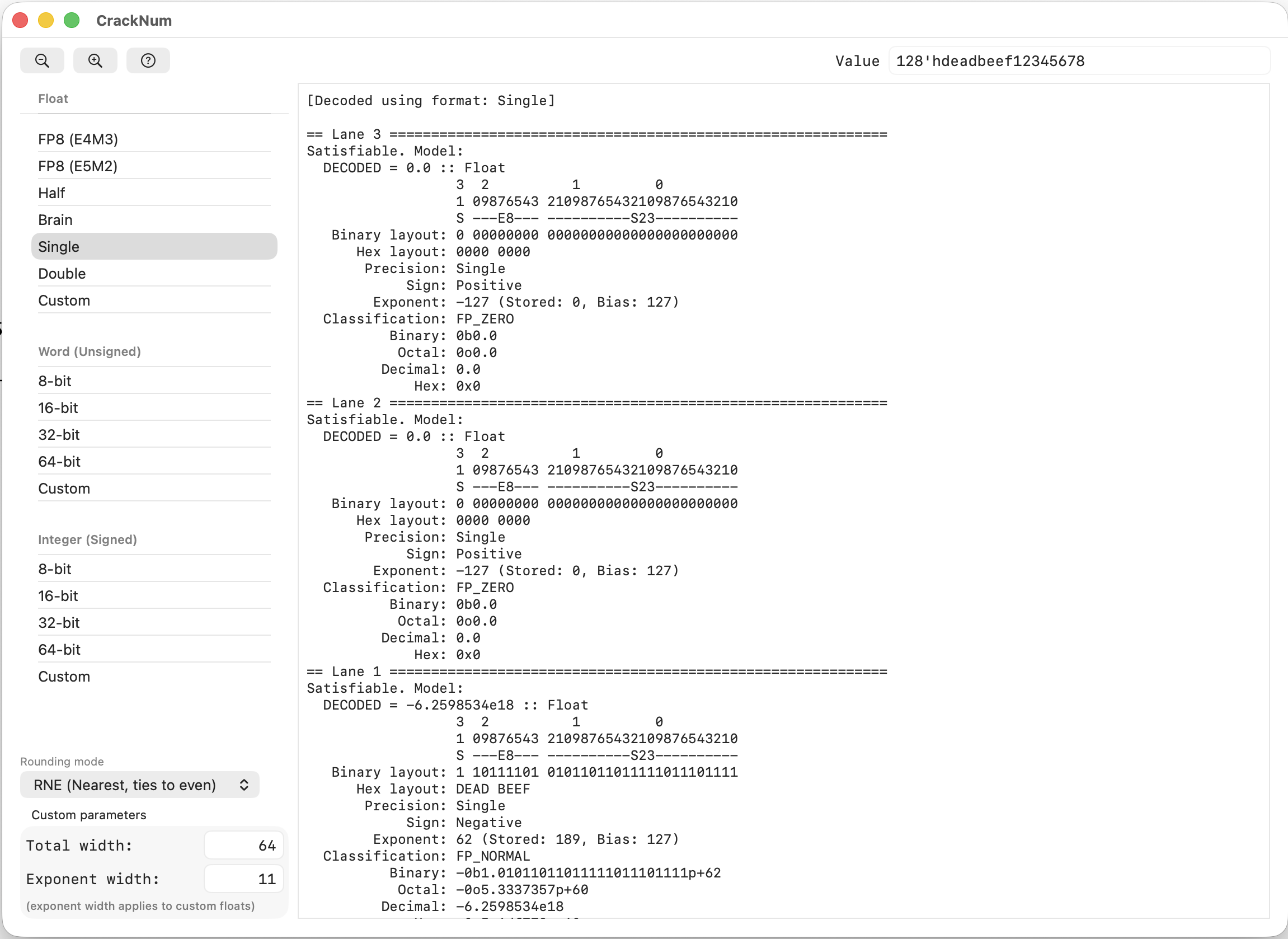
Launch it with --gui, which forwards any flags and value to the app:
$ crackNum --gui -- open the graphical interface
$ crackNum --gui -fsp 2.5 -- open it with single-precision selected, and 2.5 cracked
$ crackNum --gui 0xdeadbeef -- open it pre-filled with a value to decode
Usage info
Usage: crackNum value OR binary/hex-pattern
-i N Signed integer of N-bits
-w N Unsigned integer of N-bits
-f fp Floating point format fp
-r rm Rounding mode to use. If not given, Nearest-ties-to-Even.
-l lanes Number of lanes to decode
-h, -? --help print help, with examples
-v --version print version info
-d --debug debug mode, developers only
--gui launch the graphical interface
--list-formats list the formats supported by -f, one per line
Supported floating-point formats (for use with -f):
hp: Half float ( 5 + 11)
bp: Brain float ( 8 + 8)
tf32: TensorFloat-32 ( 8 + 11)
sp: Single precision ( 8 + 24)
dp: Double precision (11 + 53)
qp: Quad precision (15 + 113)
a+b: Arbitrary IEEE-754 ( a + b)
e5m2: FP8 format (IEEE-754) ( 5 + 3)
e4m3: FP8 format (Alternate) ( 4 + 4)
fp4: FP4 format (E2M1) ( 2 + 2)
fp4e0m3: FP4 format (E0M3) ( 0 + 3)
e8m0: FP8 format (MX scale) ( 8 + 0)
Examples:
Encoding:
crackNum -i4 -- -2 -- encode as 4-bit signed integer
crackNum -w4 2 -- encode as 4-bit unsigned integer
crackNum -f3+4 2.5 -- encode as float with 3 bits exponent, 4 bits significand
crackNum -f3+4 2.5 -rRTZ -- encode as above, but use RTZ rounding mode.
crackNum -fbp 2.5 -- encode as a brain-precision float
crackNum -ftf32 2.5 -- encode as a TensorFloat-32 float
crackNum -fdp 2.5 -- encode as a double-precision float
crackNum -fqp 2.5 -- encode as a quad-precision float
crackNum -fe4m3 2.5 -- encode as an E4M3 FP8 float
crackNum -fe5m2 2.5 -- encode as an E5M2 FP8 float
crackNum -ffp4 2.5 -- encode as an FP4 (E2M1) float
crackNum -ffp4e0m3 3.5 -- encode as an FP4 (E0M3) sign-magnitude integer
crackNum -fe8m0 2.5 -- encode as an E8M0 MX scale (power of two)
crackNum -fsp 0x3.2p5 -- encode as single-precision from hex-float
Decoding:
crackNum -i4 0b0110 -- decode as 4-bit signed integer, from binary
crackNum -w4 0xE -- decode as 4-bit unsigned integer, from hex
crackNum -f3+4 0b0111001 -- decode as float with 3 bits exponent, 4 bits significand
crackNum -fbp 0x000F -- decode as a brain-precision float
crackNum -ftf32 19\'h0000F -- decode as a TensorFloat-32 float
crackNum -fdp 0x8000000000000000 -- decode as a double-precision float
crackNum -fhp 0x8000 -- decode as a half-precision float
crackNum -ffp4 0b0111 -- decode as an FP4 (E2M1) float
crackNum -ffp4e0m3 0b1101 -- decode as an FP4 (E0M3) sign-magnitude integer
crackNum -fe8m0 0x7F -- decode as an E8M0 MX scale (power of two)
crackNum -l4 -fhp 64\'hbdffaaffdc71fc60 -- decode as half-precision float over 4 lanes using verilog notation
GUI:
crackNum --gui -- launch the graphical interface
crackNum --gui 0xdeadbeef -- launch the GUI, pre-filled with the given value
crackNum --gui -fsp 0xdeadbeef -- launch the GUI, using the given format
Notes:
- For encoding:
- Use -- to separate your argument if it's a negative number.
- For floats: You can pass in NaN, Inf, -0, -Inf etc as the argument
along with a decimal (2.3, -4.1e5) or hexadecimal float (0x2.4p3)
- FP4 (E2M1) has neither NaN nor Inf, so those inputs are rejected. Finite
values outside its range of [-6, 6] saturate to the nearest end-point.
- FP4 (E0M3) is a sign-magnitude integer: a sign bit and a 3-bit magnitude,
covering -7 to 7, with both a positive and a negative zero. It has no NaN
and no Inf either, and values outside [-7, 7] saturate to the end-point.
- E8M0 (MX scale) is all exponent: no sign bit and no significand at all,
so every value is a power of two, from 2^-127 to 2^127. It has no zero
and no Inf, and 0xFF is its only NaN. Negative inputs are rejected;
values outside the range saturate to the nearest end-point.
- For decoding:
- Use hexadecimal (0x) binary (0b), or N'h (verilog) notation as input.
Input must have one of these prefixes.
- You can use _,- or space as a digit to improve readability for the pattern to be decoded
- With -lN parameter, you can decode multiple lanes of data.
- If you use verilog input format, then we will infer the number of lanes unless you provide it.
VIM users: crackNum.vim
cracks the text under the cursor with :CrackNum options.
Changes
-
Latest Hackage released version: 4.2, 2026-08-25
Version 4.2, 2026-08-25
-
Documentation only; no functional changes.
-
Simplified the README’s download section further. It is now just the three platforms, each linking to the latest release. The per-platform notes (static linking, the macOS quarantine flag, the Windows SmartScreen prompt) and the unpack/PATH instructions are gone from here – every bundle ships a
README.txtthat covers them for that platform, and it is the first thing you see when you unpack. -
Trimmed the note about needing z3 when installing from Hackage.
Version 4.1, 2026-08-25
-
Documentation only; no functional changes.
-
Substantially shortened the README. It had grown to fifteen worked examples, all showing the same output fields with different numbers in them, plus a copy of the per-platform install commands that already ship inside every release bundle. The examples are down to four – an encode with a non-default rounding mode, a decode, an E8M0 encode, and a two-lane decode – and the install section now points at the
README.txtin the bundle rather than repeating it, so those steps have a single home and cannot drift. -
The “Supported formats” section is now just the flag table. The per-format prose that followed it – the FP4 (E0M3) and E8M0 explanations, the integer flavors, the TF32 bit-count note – is gone; the first three were already stated in the
--helpoutput reproduced further down. -
Downloading a prebuilt binary is now the first thing the README talks about, under its own heading, instead of being a sub-section whose point was hidden in a parenthetical. Building from Hackage is presented as the alternative, and each platform bullet links to the latest release.
-
Replaced the README’s markdown tables with lists. Hackage renders the README outside the
#descriptionpane, and its stylesheet only borders tables inside that pane, so a table there comes out unstyled and the columns run together. -
Dropped the per-platform GUI build instructions from the README; each GUI’s own directory documents itself.
GUI/winGUI/README.mdis new;GUI/swiftGUI/andGUI/tclGUI/already had one. The note about needingwishon Linux went with it – whenwishis missing, the binary already prints theapt/dnf/nixcommand to install it. -
Reworded the cabal Description’s pointer to the releases page: it now leads with not needing a Haskell toolchain, rather than with the word “releases”.
Version 4.0, 2026-08-24
-
The Windows GUI now carries the CrackNum icon instead of the stock WinForms one. The artwork is rendered by the same generator that produces the macOS AppIcon.icns, so the two platforms cannot drift apart.
-
Note on numbering: 3.32 was tagged and published as a GitHub release, but never uploaded to Hackage. So for anyone installing from Hackage, this is the first version to support Windows – see the 3.32 entry below for what that involves.
Version 3.32, 2026-08-24
-
Windows is now a supported platform, with a prebuilt bundle (
crackNum-<version>-windows-x86_64.zip) alongside the Mac and Linux ones. It carries the CLI, a native GUI, and a copy of z3, and needs nothing installed: the GUI targets .NET Framework 4.8, which ships with Windows 10 and 11, and z3 brings its own Microsoft C runtime. The binaries are not code-signed, so SmartScreen warns on first run; the bundled README says how to get past it. -
The Windows GUI (
GUI/winGUI/) is a native WinForms application rather than a port of the Tcl/Tk script that serves Linux. Reusing the Tcl would have been a far smaller change, but it would have required users to install a Tcl distribution before--guidid anything, and a GUI behind a prerequisite that most people will not clear is worth less than the code it saves. -
--versionand the usage text no longer print the executable’s.exeextension on Windows, wheregetProgNamekeeps it. -
The golden test suite writes its temporary files with newline translation turned off, so the golds stay LF everywhere. Previously, running the suite on Windows compared CRLF output against LF golds, and
--acceptthere would have rewritten every gold in the process.
Version 3.31, 2026-08-22
-
The Hackage description now shows a screenshot of the GUI, and points at the releases page for the prebuilt Mac and Linux bundles. The screenshot was dropped from README.md in the same breath: Hackage renders the README below the description, so keeping it in both would have shown the same image twice on one page.
-
The READMEs shipped inside the binary bundles now walk through a single install sequence – unpack, place the files, set PATH, check – instead of splitting the CLI and the GUI into separately numbered steps that had to cross-reference each other. The macOS one leads with the quarantine removal, since nothing runs before that.
Version 3.30, 2026-08-21
-
The GUIs now group the floating-point formats by provenance instead of listing all twelve of them in one flat “Float” section. The formats that exist because of machine learning – FP4 (E2M1), FP4 (E0M3), FP8 (E4M3), FP8 (E5M2), FP8 (E8M0), Brain, and TF32 – come first under “AI formats”, followed by the IEEE-754 ones (Half, Single, Double, Quad, and Custom) under “IEEE-754”. Integers now precede words, so the sidebar reads AI formats, IEEE-754, Integer (Signed), Word (Unsigned). Both the macOS (Swift) and the Tcl/Tk GUI are grouped identically. No format was added, removed, or renamed, and the command line is unaffected.
-
The “Custom parameters” box in the GUIs is now titled “Custom IEEE-754 float:”, and its heading lines up flush left with “Rounding mode” above it rather than being indented past it. The “(exponent width applies to custom floats)” note is gone, the new title having made it redundant. Note that the “Total width” field also applies to the Custom entries under Integer (Signed) and Word (Unsigned), which take a width but no exponent.
-
The format list in the Tcl/Tk GUI now has a vertical scrollbar. With four sections it is taller than the sidebar at the default window size, and without a scrollbar the formats past the bottom were not merely off-screen but unreachable. (The macOS GUI needed no equivalent change; its list already scrolled.)
-
Scrollbars in the Tcl/Tk GUI now appear only when there is something to scroll to, rather than always taking up room. This covers the output pane’s pair as well as the new one on the format list.
-
Internally,
Main.hshas been split into per-topic modules –CrackNum.Types,.Formats,.Options,.Utils,.Output,.GUI,.Decode, and.Encode– leavingMainwith just the argument dispatch. It had grown to some 1400 lines holding everything from option parsing to the hand-rolled layouts for the formats that have no IEEE look-alike. This is purely a reorganization: every definition moved verbatim, so there is no change in behavior or output.
Version 3.29, 2026-08-21
crackNum.vim’s TAB completion no longer offers a hardcoded set of-lNlane counts, since-lNis never valid on its own and always needs pairing with a-f/-i/-wflag; type it directly instead.-i/-wcompletion now offers the bare flag and prompts for the bit-width separately, rather than baking in a fixed set of widths – crackNum accepts any-iN/-wN, so there was never a complete list to offer.
Version 3.28, 2026-08-21
-
Add support for the E8M0 format, via
-fe8m0. This is the shared scale of the OCP Microscaling (MX) formats: the value that scales a block of MXFP8/MXFP6/MXFP4 elements, all of which crackNum already knew about. It is the mirror image of FP4 (E0M3): where that format is all significand and no exponent, E8M0 is all exponent and no significand, with no sign bit either. Every value it holds is therefore a power of two, from 2^-127 to 2^127.Note that it has no zero and no subnormals – with nothing for the all-zero encoding to mean, it simply denotes 2^-127 – and no infinities.
0xFFis its one and only NaN. Negative inputs are rejected rather than saturated: with no sign bit there is no direction to saturate towards, and clamping would quietly turn a negative into a positive. Values outside the range, infinity included, saturate to the nearest end-point, and anything that is not a power of two rounds according to-r.
Version 3.27, 2026-08-20
-
There is now a Linux binary distribution, alongside the macOS one: see the Releases page. It ships the
crackNumexecutable, a copy ofz3(which crackNum shells out to for every operation), the Tcl/Tk GUI script, and a README. Both binaries are statically linked, so there is no libc or distribution requirement: they run as-is on any x86_64 Linux, old or new. The GUI additionally needswish, which does have to come from your system. -
--guinow also looks forcrackNum.tclnext to the crackNum executable itself, after$CRACKNUM_TCLand the PATH but before the cabal data-directory. A binary distribution carries the script alongside the binary, where the data-directory baked in at build time names a path from the build machine that does not exist on the user’s; the GUI now works in such a bundle however it is unpacked or copied, rather than only when the script was also placed on the PATH.
Version 3.26, 2026-08-19
-
New flag
--list-formats, which prints the floating-point formats-faccepts, one name per line. It is meant for editor integrations, which would otherwise have to hardcode the list and let it go stale; the VIM plugin now asks rather than guesses, and picks up any format added later for free. -
--helpnow also lists the supported floating-point formats. Both it and the-ferror message are generated from a single table, so they cannot disagree. -
Fix the VIM integration, which had been broken since version 3.0. The plugin offered
i,w, andfas the choices at its precision prompt, and passed whichever you picked through as-is, so:CrackNumrancrackNum i 0b0110: no leading dash, and no bit-width. Every invocation was rejected, and the quickfix window filled up with crackNum’s usage text instead of an answer. The completion list now offers real flags (-i8,-fhp, …), and anything else crackNum accepts, such as-f3+4or-l4 -fhp, can be typed in directly. -
The VIM plugin also set
grepformattoVIM %m, matching a--vimoutput mode that was removed in 3.0. Nothing matched that format, so even a correct invocation produced an empty quickfix window. Take crackNum’s output as-is now. -
The VIM plugin now finds the bit-pattern under the cursor itself, instead of relying on
<cword>. Verilog notation stops at the quote (64'hdeadbeefcame out as just64), and the value is quoted before it reaches the shell.
Version 3.25, 2026-08-18
-
Add support for the FP4 (E0M3) format, via
-ffp4e0m3. Unlike every other format crackNum knows about, this one has no exponent bits at all, which makes it a plain 4-bit sign-magnitude integer: a sign bit and a 3-bit magnitude, covering -7 to 7, with both a positive and a negative zero. It has neither NaN nor Inf, so those inputs are rejected; values outside [-7, 7] saturate to the nearest end-point, and fractional inputs round according to-r. -
Report the format the user actually asked for when decoding E4M3 and FP4. Both are modeled by an IEEE look-alike, and the patterns that need no special handling were printed straight from it, so
crackNum -ffp4 0b0100answered2.0 :: FloatingPoint 2 2andcrackNum -fe4m3 0b00111000answered1.0 :: FloatingPoint 4 4. The values were right, only the type name leaked. The patterns that do deviate, and E5M2 throughout, were already correct.
Version 3.24, 2026-08-17
-
Add a quad-precision example to the help output.
-fqphas always been accepted, but--helpnever mentioned it, so the only way to find out it existed was to trip over the error message for a bad-fargument. -
Bring the README up to date: document the installation steps (including the z3 requirement), add a table of all supported formats, list the rounding modes, and add worked examples for the FP8, FP4, TF32, and unsigned-word formats. A couple of the existing sample outputs had drifted from what the tool actually prints, and are now regenerated.
Version 3.23, 2026-08-17
-
Do not ignore bad flags when
--guiis given. A mistyped format, such ascrackNum -ft32 4 --gui, used to bring the GUI up with nothing selected, silently swallowing the error the command line would have reported. We now diagnose the flag first, and only launch the GUI if everything checks out. -
Add quad-precision (
-fqp) to the format list in both GUIs. It was accepted on the command line, but was missing from the interfaces.
Version 3.22, 2026-08-17
- Fix text alignment in the Tcl/Tk GUI’s entry fields. We asked for the
Courierfont, which on X11 is an alias that typically resolves to Nimbus Mono PS. Its ascent/descent split is lopsided (9/6 at size 11), and since an entry centers text on the linespace, the glyphs ended up hugging the top of the box with a large gap underneath. We now pick the first monospaced family that is actually installed, preferring ones with sane metrics.
Version 3.21, 2026-08-16
- Add support for TF32 (TensorFloat-32), via
-ftf32. This is the 19-bit format with 8 exponent and 10 significand bits, i.e., the exponent range of single precision with the significand of half precision. Note that we crack the 19 architectural bits; hardware typically carries these in a 32-bit container with the remaining bits unused.
Version 3.20, 2026-08-13
- Fix tool lookup in both GUIs: a directory named
crackNum(orz3) sitting on the PATH was accepted as the executable, since directories carry the search bit and so look executable. The GUI would then fail with a “permission denied” on that directory. We now require a regular file.
Version 3.19, 2026-08-13
-
Fix decoding in the Tcl/Tk GUI: hex and binary input was silently converted to decimal before being handed to
crackNum, so entering0xdeadbeefencoded the value 3735928559 instead of decoding the bit-pattern. Verilog (N'h) input was unaffected. -
Drop the lane count from both GUIs. The number of lanes is inferred from Verilog (
N'h) input, and everything else is a single lane, so there was nothing useful for the interface to set.
Version 3.18, 2026-08-13
-
Add a Tcl/Tk GUI (
GUI/tclGUI/crackNum.tcl) that works on Linux and macOS. When--guiis used on Linux,crackNumnow launches this interface (requireswish) instead of erroring out. -
The Tcl/Tk GUI script is now a cabal data-file, so it is installed along with the binary:
cabal install crackNumis enough forcrackNum --guito work on Linux, with no PATH setup. To run a different copy of the script, setCRACKNUM_TCL, or put it on your PATH ascrackNum.tcl. -
Both front-ends now live under
GUI/: the macOS app moved fromgui/toGUI/swiftGUI/, and the Tcl/Tk script toGUI/tclGUI/. -
Encoding a NaN now always displays the canonical quiet-NaN pattern (sign 0, all-ones exponent, leading significand bit set;
0x7FC00000for a single). SMTLib’s floating-point sort has a single NaN value, so the solver returns an abstract NaN and the concrete bit-pattern shown was whatever the model materialized – which could differ between solver/library versions. The E4M3 path already pinned its NaN this way; the rest now do too. -
Exponent/significand sizes of 1 bit are accepted by
-f, but the solver requires at least 2 of each. This now produces a regular error message instead of an uncaught exception with a backtrace.
Version 3.17, 2026-08-10
- Add support for the FP4 (E2M1) format, via
-ffp4. Like E4M3, this format deviates from IEEE-754: The all-ones exponent encodes the values 4 and 6, instead of infinity and NaN. Consequently, FP4 can represent neither NaN nor infinity, and finite values outside of [-6, 6] saturate to the end-points.
Version 3.16, 2026-07-24
- Add the
--guioption, launching a graphical interface (macOS) for interactively encoding/decoding values.
Version 3.15, 2024-11-09
- Bump up SBV dependence to >= 11.0
Version 3.14, 2024-09-23
- Fix README
Version 3.13, 2024-09-23
- Fix help text
Version 3.12, 2024-04-05
- Fix hexadecimal float parsing for e4m3
Version 3.11, 2024-04-05
- Allow for encoding of hexadecimal floats
Version 3.10, 2024-03-01
- More relaxed parsing for verilog input format
Version 3.9, 2024-02-23
- Fix verilog input format parsing
Version 3.8, 2024-02-21
-
Add support for FP8 formats, as decribed in: https://arxiv.org/pdf/2209.05433.pdf
- E5M2: Which is essentially a synonym for f5+3
- E4M3: Similar to f4+4, except it does not have infinities and interprets NaN values differently
-
Fix a bug in cracking of arbitrary-sized floats, that yielded wrong values for some NaN cases
Version 3.7, 2024-02-15
-
Support signaling/quiet indication for decoded NaN values.
-
Add support for decoding over multiple lanes. See the -l option.
-
Add support for verilog bit-vector notation, e.g., 128’hXXX. If you use this notation, crackNum will automatically infer the number of lanes to crack based on the width given; unless explicitly specified.
Version 3.6, 2024-01-24
- Be more clear when the provided input isn’t a recognizable float, instead of treating it as NaN implicitly. Thanks to Dmitry Blotsky for pointing out the confusion.
Version 3.5, 2024-01-11
- Resolve compilation issues with GHC 9.8 series
Version 3.4, 2023-04-14
- Fix compilation in previous build
Version 3.3, 2023-04-14
- Allow compilation with newer versions of SBV
Version 3.2, 2021-06-30
- Add an explicit note when conversion is exact.
Version 3.1, 2021-03-29
- Fix readme
Version 3.0, 2021-03-29
- A complete rewrite, much simplified, and supporting arbitrary precision floats. Some of the old features and the library are dropped; so if you rely on the library nature of CrackNum, do not upgrade. For other users who merely use crackNum as an executable, the new version is strongly recommended.
Version 2.4, 2020-09-05
- Changes required to compile cleanly with GHC 8.10.2
Version 2.3, 2018-11-17
- Remove dependency on the ieee754 and reinterpret-cast packages. The goal is to remove any FFI dependencies. We now define and export the required utilities directly in the CrackNum package.
Version 2.2, 2018-09-01
- Instead of data-binary-ieee754, use reinterpret-cast package. According to documents, the former is deprecated.
Version 2.1, 2018-07-20
- Support for vi-editor bindings. See the file “crackNum.vim” in the distribution or in the github repo You can put “so ~/.vim/crackNum.vim” (use the correct path!) and have vi crack numbers directly from inside your editor. Simply locate your cursor on a binary/hex stream of digits and type “:CrackNum”. See the “crackNum.vim” file for binding details.
Version 2.0, 2018-03-17
- Import FloatingHex qualified to avoid GHC 8.4.1 compilation issue
Version 1.9, 2017-01-22
- Minor fix to printing of +/-0
Version 1.8, 2017-01-15
- Bump up FloatingHex dependency to >0.4, this enables proper support for large doubles
Version 1.7, 2017-01-14
- Fix a snafu in reading hexadecimal floats
Version 1.6, 2017-01-14
- Add support for hexadecimal-floats. These now work both in toIEEE option as input, and also when printing the values out. (i.e., numbers of the form 0x1.abp-3, etc.)
Version 1.5, 2016-01-23
- Typo fixes; no functionality changes
Version 1.4, 2016-01-17
- Fix NaN nomenclature: Screaming->Signaling
- Add an example to README.md
Version 1.3, 2015-04-11
- Fix docs, github location
Version 1.2, 2015-04-11
- Fix the constant qnan values for SP/DP
- Add conversions from float/double. Much easier to use.
- Better handling of nan values.
Version 1.1, 2015-04-02
- Clean-up the API, examples etc.
Version 1.0, 2015-04-01
- First implementation. Supports HP/SP/DP and signed/unsigned numbers in 8/16/32/64 bits.